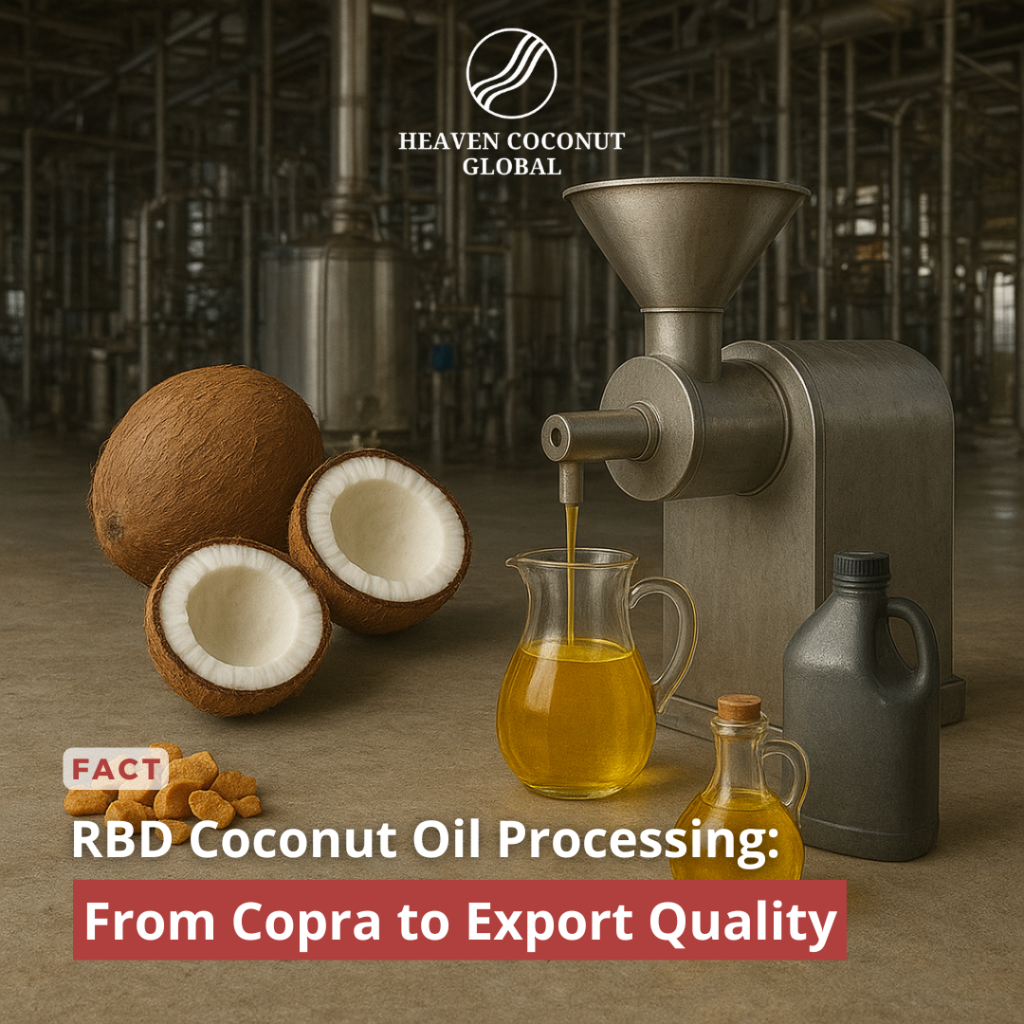
RBD Coconut Oil Processing: From Copra to Export Quality
RBD Coconut Oil (Refined, Bleached, and Deodorized Coconut Oil) plays a vital role in global food manufacturing and cosmetic production. Buyers prefer it for its neutral taste, long shelf life, and versatility. Producers create this oil from copra, the dried kernel of coconuts, through a step-by-step refining process that ensures consistent quality.
For international buyers, understanding this process helps them choose the right supplier, assess quality, and negotiate better deals.
1. Selecting High-Quality Copra
The process starts with copra, the dried meat of mature coconuts. Farmers in tropical regions such as Indonesia and the Philippines harvest and dry the kernels. Quality control teams check moisture levels, look for mold, and reject damaged pieces. This careful selection results in higher oil yields and superior quality.
2. Extracting Oil from Copra
Processors use two main methods to obtain crude coconut oil (CNO):
-
Mechanical pressing squeezes oil from the copra with expeller machines.
-
Solvent extraction uses a food-grade solvent to maximize oil recovery.
At this stage, the oil contains impurities, free fatty acids, and a strong coconut aroma. Therefore, it still requires refining before it becomes suitable for large-scale food or cosmetic use.
3. Refining: Transforming Crude Oil into RBD Coconut Oil
The refining stage involves three critical steps:
a) Refining (Neutralization)
Technicians treat crude coconut oil with an alkaline solution. This process neutralizes free fatty acids and removes impurities, improving the oil’s stability.
b) Bleaching
The oil passes through natural bleaching earth or activated carbon. As a result, unwanted color pigments and contaminants disappear, leaving a pale yellow liquid.
c) Deodorizing
Finally, high-temperature steam distillation removes odors and flavors. Consequently, the oil gains a neutral taste and aroma, making it suitable for various applications.
4. Quality Testing and Packaging
After refining, quality control teams test every batch. They measure free fatty acids, peroxide values, moisture content, and color clarity. Only oil that meets export standards moves forward.
Next, workers pack the RBD Coconut Oil in bulk containers such as drums, flexitanks, or IBC totes. Some shipments go into smaller retail packaging for specific buyers.
5. Applications in Global Markets
Manufacturers use RBD Coconut Oil in:
-
Food – Bakery, confectionery, snack production, and frying
-
Cosmetics – Lotions, soaps, creams, and hair care products
-
Industrial – Oleochemicals and specialty fats
Its stability, neutral profile, and long shelf life make it ideal for large-scale production.
Why Many Buyers Source from Indonesia
Indonesia ranks among the world’s largest coconut producers. The country offers:
-
Reliable raw material supply from sustainable farms
-
Competitive prices compared to some regions
-
Experienced processors with modern refining facilities
Heaven Coconut Global connects buyers to export-quality RBD Coconut Oil with a focus on consistency, compliance, and customer satisfaction.
Conclusion
From copra selection to refining, bleaching, and deodorizing, each stage plays a role in producing RBD Coconut Oil that meets global standards. As a result, buyers receive a product that supports high-performance production in both food and cosmetic industries.
📩 Contact Heaven Coconut Global today to discuss your RBD Coconut Oil sourcing needs.