Why Indonesia Remains a Top Source in 2025
Desiccated Coconut Indonesia continues to be one of the most in-demand ingredients in the global food industry. In 2025, the market outlook for desiccated coconut from Indonesia remains strong, supported by growing demand in bakery, confectionery, cereal, and plant-based sectors. Buyers choosing Indonesian suppliers benefit from consistent quality, halal certifications, and efficient logistics. This article explores Desiccated Coconut Indonesia 2025 market insights and the key advantages for international buyers.
Snapshot: What Buyers Want This Year
-
Consistency: Tight particle size control and moisture specs for predictable baking and mixing performance.
-
Food Safety: BRC/IFS/HACCP, Halal, and often Kosher certifications as standard for global markets.
-
Functional Variety: Fine, medium, macaroons; high-fat (HFDC 60–68%) vs. low-fat options; custom cuts for R&D.
-
Traceability & Sustainability: Documentation on origin, farming communities, and responsible production.
2025 Demand Drivers & Use Cases
-
Industrial Bakeries & Snacks: DC offers clean label texture, visible inclusion, and coconut-forward aroma in breads, cakes, cookies, bars, granolas, and biscuits.
-
Confectionery & Chocolates: Desiccated coconut provides structure and a premium “chewy” bite in fillings and coatings.
-
Cereals & Plant-Based: Fits wellness trends (fiber, plant-based) and pairs with tropical flavors for limited editions.
-
Foodservice & Ice Cream: Toppings and inclusions benefit from DC’s low moisture and shelf stability.
Buyer Benefit: Indonesian DC typically delivers a neutral, clean coconut profile with low foreign matter, supporting uniform flavor release and consistent texture across large-scale runs.
Product Specifications That Matter
-
Fat Content:
-
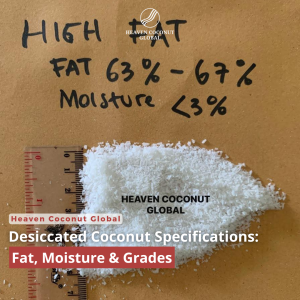
High Fat (HFDC 60–68%)—richer flavor, better mouthfeel, ideal for premium bakery and confectionery.
-
Low Fat (LFDC)—leaner profile for specific diet targets and cost optimization.
-
-
Particle Size / Grades: Fine, Medium, and Macaroons; choose based on dough matrix and desired visual.
-
Moisture: Generally ≤3% for shelf stability; verify per supplier COA.
-
Microbiologicals: Heat treatment + metal detection; suppliers target low APC, yeast & mold, and Salmonella-negative on 25g.
-
Packaging: 25 kg poly-lined kraft bags (double or triple layer) with inner food-grade liner; optional palletization and desiccant packs.
-
Shelf Life: Commonly 12–24 months from production if stored cool and dry.
Buyer Tip: Request a standard COA + COC, allergen statement, GMO-free statement, and full spec sheet aligned with your region’s regulations.
Pricing & Logistics: What to Expect in 2025
-
Pricing Drivers: Raw coconut availability, energy costs, labor, and currency movements. HFDC commands a premium over LFDC; fine grade can be priced slightly above medium due to tighter screening.
-
Trade Terms: Most deals transact on FOB Indonesia (Surabaya) or CIF to destination ports. Discuss stuffing weight optimization to lower per-metric-ton freight costs.
-
Lead Times: Typical production + booking + sailing ranges 3–6 weeks depending on seasonality and route.
-
Quality Assurance in Transit: Moisture barriers, intact pallets, and container fumigation (where applicable) reduce risk. On arrival, conduct inbound QC for moisture and microbiological spot checks.
Buyer Benefit: Indonesian exporters are accustomed to port documentation and halal markets, enabling smoother customs clearance across the Middle East, South Asia, and Africa.
Compliance & Certifications
Reputable Indonesian processors maintain:
-
GFSI-recognized schemes (BRCGS/IFS), HACCP, ISO 22000
-
Halal (widespread), Kosher (on request), and Non-GMO declarations
-
Social/Environmental add-ons (SMETA audits, sustainability statements) increasingly available
Buyer Benefit: Certifications reduce audit overhead and accelerate vendor approval.
How to Select the Right Grade for Your Application
-
Premium Cakes & Filled Chocolates: HFDC Fine for smooth mouthfeel and even distribution.
-
Cookies, Biscuits & Bars: HFDC Medium for visible texture that holds up during bake.
-
Sprinkles & Toppings: Macaroons or custom large cut to maximize crunch and visual appeal.
-
Cost-Optimized Ranges: Consider LFDC where a subtler flavor is acceptable.
Run a quick bench test: compare spread, moisture migration, bite, and visual coverage after baking or processing.
Risk Management & Sourcing Best Practices
-
Dual-Source Within Indonesia: Keep a primary and a secondary approved mill to cushion supply dips.
-
Contract Windows: Quarterly or semi-annual contracts help average out raw material and freight swings.
-
Pre-Shipment Samples: Request photos, production date, and batch samples for new POs.
-
Clear Specs in the PO: Grade, fat %, moisture limit, microbiological targets, packaging, palletization, and labeling.
-
Claims Procedure: Align on thresholds, corrective actions, and replacement timelines before shipment.
Why Buyers Choose Indonesia in 2025
-
Product Stability: Dry, shelf-stable ingredient with dependable specs.
-
Scalable Volumes: Capacity to support both spot and program buys.
-
Certifications & Halal Readiness: Streamlined approvals for global brands.
-
Value for Money: Competitive pricing-to-quality ratio vs. alternatives.
-
Responsive Lead Times: Frequent sailings from major Indonesian ports.
FAQs
Q1: What’s the typical minimum order?
Most exporters start at 1×20’ container (≈12–15 MT depending on stuffing). Some allow mixed grades per container.
Q2: Can I get custom cuts or blends?
Yes—many mills offer custom particle sizes and blends after R&D approval and MOQs.
Q3: How do I ensure consistent sensory results?
Lock in a fixed-grade spec + approved vendor list, then perform per-shipment sensory and moisture checks on intake.
Q4: Is HFDC always better?
HFDC offers richer flavor and mouthfeel, but LFDC can be ideal for cost-sensitive products or lighter profiles.
Q5: What about allergens?
Desiccated coconut is generally treated as a tree nut or specific coconut allergen depending on local regulations. Request a current allergen statement.
Sourcing From Indonesia: A Simple Checklist
-
Define grade, fat %, moisture, microbiological limits, and packaging.
-
Collect COA/COC, certifications, allergen & GMO statements.
-
Confirm Incoterms (FOB/CIF), port, lead time, payment terms (LC/TT).
-
Align on palletization and container loading plan to maximize net weight.
-
Schedule pre-shipment inspection (where needed) and clarify claims.
Work With a Trusted Export Partner
If you’re seeking a reliable Indonesian supply of desiccated coconut, Heaven Coconut Global can help coordinate:
-
HFDC Fine & Medium with consistent specs and full documentation
-
Halal, HACCP, and GFSI-aligned production partners
-
CIF quotes to major ports with optimized freight and clear communication
Ready to evaluate samples or request a CIF quote? Share your target grade, fat %, monthly volume, and destination port, and we’ll prepare a tailored offer including indicative lead time and documentation list.