Packaging Standards for Exporting Desiccated Coconut: What Buyers Should Know
Desiccated coconut packaging standards play a critical role in protecting food ingredients during long-distance shipment and international trade. However, many quality issues in desiccated coconut exports are caused not by production, but by inadequate packaging.
Therefore, understanding proper packaging standards is essential for buyers who want to avoid moisture damage, contamination, and product rejection at destination ports.
Why Packaging Matters in Desiccated Coconut Exports
Desiccated coconut is highly sensitive to moisture, external odors, and contamination. As a result, even minor packaging failures can significantly affect product quality. For this reason, export-grade packaging is designed not only to contain the product, but also to protect it throughout extended transit periods and varying climate conditions.
Moreover, packaging is often the last line of defense between a compliant shipment and a costly quality claim. Consequently, buyers should treat packaging as a quality factor, not a logistical afterthought.
Common Packaging Types Used for Desiccated Coconut
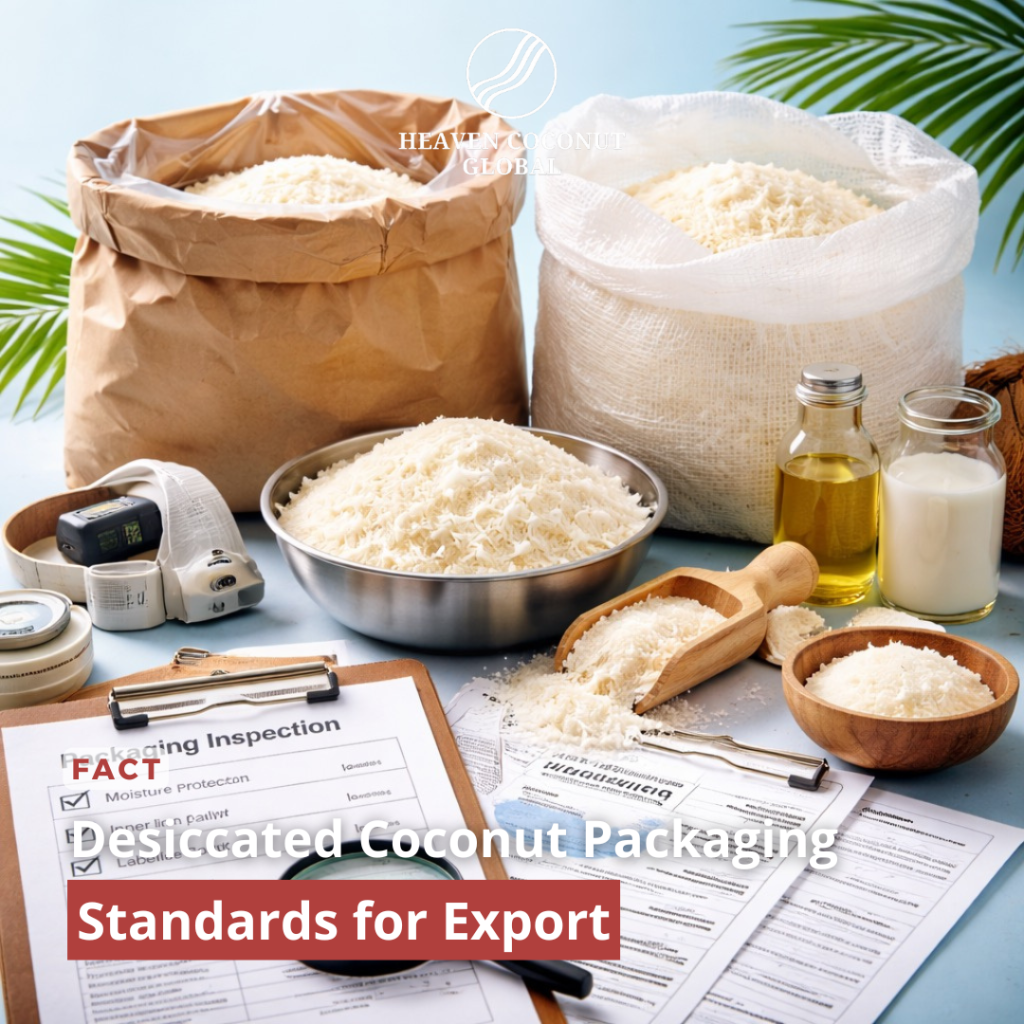
In general, international buyers encounter two main packaging options when sourcing desiccated coconut for export.
Multi-Layer Paper Bags with Inner Plastic Liner
For example, multi-layer paper bags are widely used because they provide strong stacking support. At the same time, the inner plastic liner protects the product from moisture and contamination during shipment.
Polypropylene (PP) Bags with Inner Plastic Liner
Alternatively, PP bags are known for their durability and resistance to tearing. In addition, when combined with a proper inner liner, PP bags offer reliable protection for long-distance exports.
Regardless of the outer material, the inner liner is essential for maintaining product integrity.
The Importance of Inner Plastic Liners
In addition, one of the most frequent causes of quality complaints is the absence or poor quality of inner plastic liners. Therefore, buyers should always confirm liner thickness, sealing quality, and material suitability before shipment.
Inner liners serve several key functions. For instance, they prevent moisture ingress, reduce exposure to external odors, and protect the product from contamination during handling and storage. As a result, liner quality directly impacts shelf life and product stability.
Moisture Control and Contamination Risks
Moisture is one of the biggest risks in desiccated coconut exports. Therefore, even small increases in moisture content can lead to mold growth or shortened shelf life. Moreover, high humidity during transit can accelerate quality deterioration if packaging is inadequate.
Proper packaging helps maintain moisture levels within specification. At the same time, it minimizes contamination risks during loading, unloading, and port handling.
Labeling and Handling Considerations
Furthermore, export packaging should include clear and accurate labeling to support smooth logistics and customs clearance. Typical labels include product name, grade, net weight, batch number, country of origin, and storage instructions.
Clear labeling improves traceability. As a result, it reduces delays, misidentification, and unnecessary inspections at destination ports.
Packaging and Long-Distance Shipping Conditions
Desiccated coconut is often shipped over several weeks and across multiple climate zones. Consequently, packaging must withstand temperature fluctuations, humidity changes, and repeated handling.
Export-grade packaging is designed for these conditions. Therefore, buyers should confirm that packaging standards match the destination market’s transit and storage requirements.
Common Packaging Mistakes Buyers Should Avoid
In contrast, many quality issues occur when packaging decisions are made based on cost alone. Common mistakes include ignoring inner liner specifications, assuming all suppliers use the same packaging standards, and failing to confirm packaging details before shipment.
As a result, buyers may face avoidable claims, delays, or product rejection.
Final Thoughts
Ultimately, packaging is not a secondary detail in desiccated coconut exports. Instead, it is a critical factor that directly affects product quality, safety, and delivery success. Therefore, buyers who understand packaging standards are better equipped to protect their supply chain and build long-term partnerships.
At Heaven Coconut Global, we recognize that proper packaging is an essential part of reliable international trade. By aligning packaging standards with export requirements, both buyers and suppliers can ensure smoother transactions and consistent quality delivery